Disclaimer: This is Untrue.
2.4.1 The Druze and the Knights Templar
2.4.1.1 Overview
The mastery of the world by Jewish individuals and organizations appears to have begun with the Knights Templar. This can be understood by comparing their history with that of the Children of Israel.
This section will explain that connection by repeating the
History of the Children of Israel (in light italic) after "Frank."
Additionally, origin of the Druze should be learned.
2.4.1.2 Details
>>>>>>>>>>>>
2.3.4.7 Frank
On the other hand, it is said that a significant Jewish population lived in present-day France (as of 2020 CE)
during the reign of Charlemagne (around 800 CE), the King of the Franks, who also ruled over present-day Germany.
During this time, Jewish communities were established in the Rhineland region (in the western part of present-day Germany), particularly in Mainz, Worms, and Speyer. These communities may have included descendants of converts to Judaism.
The Rhineland settlements are considered the historical heart of the Ashkenazi Jewish population. They serve as an important clue to understanding the complex origins of Ashkenazi Jews.
In addition to Mainz, Worms, and Speyer, Cologne (then Colonia) also became a significant center for Jewish settlement.
It is also noteworthy that the Rothschild and Rockefeller families, prominent in later history, originated from Frankfurt am Main.
*
"Cologne on Wikipedia"
http://en.wikipedia.org/wiki/Cologne
*
"Mainz on Wikipedia"
http://en.wikipedia.org/wiki/Mainz
*
"Worms on Wikipedia"
http://en.wikipedia.org/wiki/Worms,_Germany
*
"Speyer on Wikipedia"
http://en.wikipedia.org/wiki/Speyer
*
"Frankfurt am Main on Wikipedia"
http://en.wikipedia.org/wiki/Frankfurt
2.3.4.8 Cordoba
On the other hand, it is said that around 40,000 Jewish people lived peacefully alongside Muslims in Baghdad (approximately 85 km north of Babylon) as of 900 CE.
Hasdai ibn Shaprut was a prominent Jewish figure in Cordoba around 960 CE. He is said to have corresponded with scholars in Babylonia and played a key role in transferring the center of Jewish theological study from Babylon to Cordoba. At that time, Cordoba was the primary center of Jewish life.
Jewish people were generally proficient in commerce, including the slave trade, due to the extensive Jewish information networks that spanned a vast region. It should be noted that the slave trade was a widespread practice throughout world history.
*
"Hasdai ibn Shaprut on Wikipedia"
http://en.wikipedia.org/wiki/Hasdai_ibn_Shaprut
*
"Jewish Encyclopedia Slave Trade"
http://www.jewishencyclopedia.com/articles/13798-slave-trade
*
"History of Slavery on Wikipedia"
http://en.wikipedia.org/wiki/History_of_slavery#The_Vikings_and_Scandinavia
2.3.4.9 Kievan Rus' and Fall of Khazaria
The East Slavic population around Kiev suffered from nearby powers. They then allied with the
Varangian people (a group of Viking raiders) from the Scandinavian Peninsula. The
Varangians merged with the East Slavic population, and this Viking-influenced group
established the state of Kievan Rus' around 882 CE near present-day
Kiev (as of 2020 CE), west of Khazaria.
*
"Varangians on Wikipedia"
https://en.wikipedia.org/wiki/Varangians
*
"Kievan Rus' on Wikipedia"
https://en.wikipedia.org/wiki/Kievan_Rus%27
Khazaria collapsed at the hands of Kievan Rus' in 965 CE. However, people of the
Jewish faith seem to have continued living in the region formerly part of Khazaria.
The following entry from the Encyclopaedia Judaica lists Jewish individuals and towns
around Kiev after the fall of Khazaria. One character, called "Ephraim son," appears in a
document and may evoke associations with the Lost Tribes of Israel,
though it could simply have been a common Jewish name like Jacobson.
*
"Jewish Virtual Library Kiev"
http://www.jewishvirtuallibrary.org/jsource/judaica/ ejud_0002_0012_0_11117.html
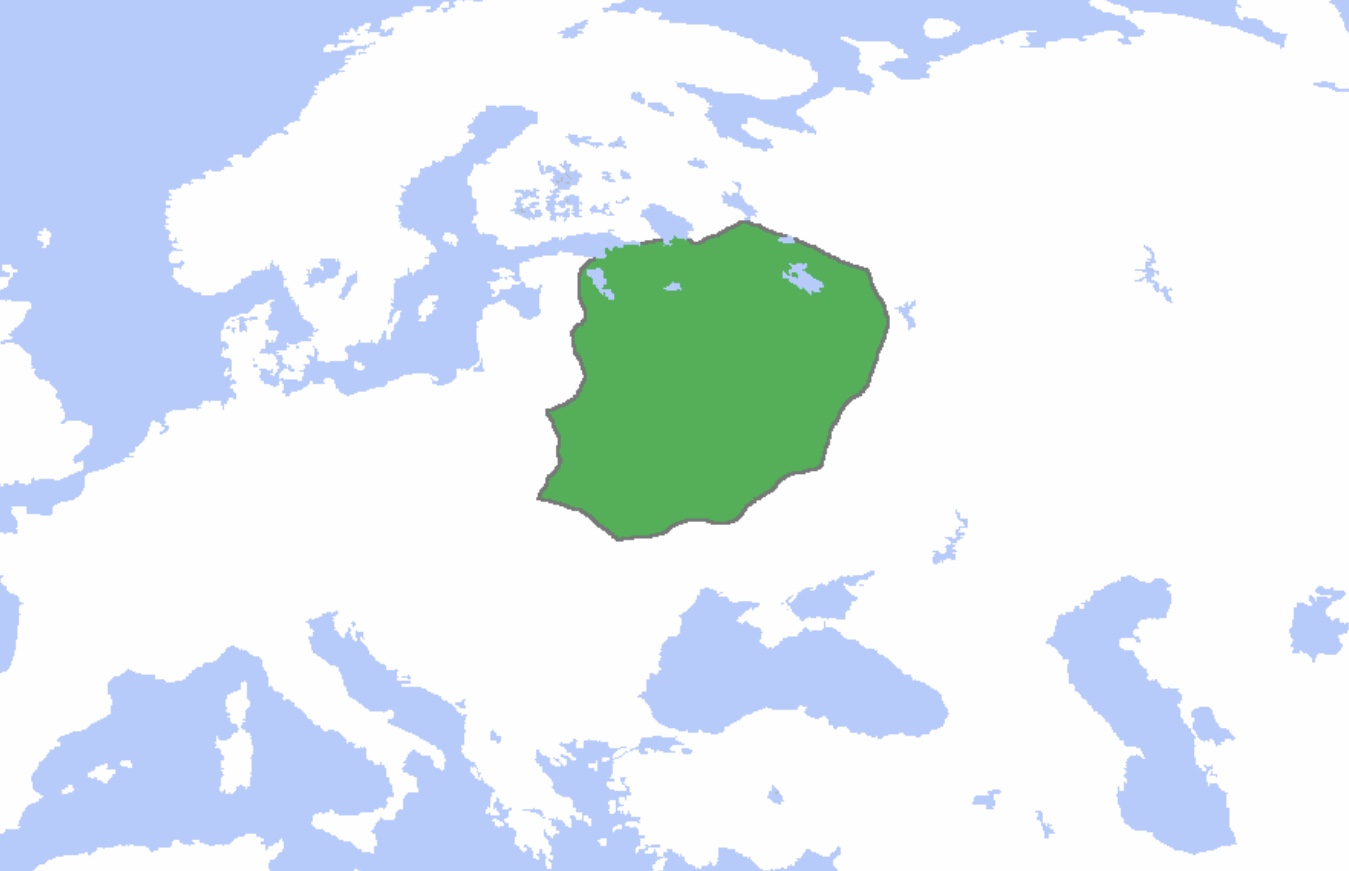
Territory of Kievan Rus' as of 1000 CE
*Attribution:
https://en.wikipedia.org/wiki/File:KievanRus1000.png
In 988 CE, Grand Prince Vladimir I of Kievan Rus' marched toward Constantinople to threaten the Byzantine Empire. However, he converted to the Orthodox Christian Church of the Byzantine Empire and withdrew his troops.
Additionally, it is said that a certain number of Jewish people from Khazaria migrated
northwestward to Kievan Rus'.
>>>>>>>>>>>>
2.4.1.2.1 Druze
Prior to the explanations of the Knights Templar, the Druze should be discussed.
The Druze are followers of a monotheistic religion that emerged from Ismailism, a branch of Shi'a Islam, beginning around 1017 CE in present-day Egypt (as of 2020 CE) (during the Fatimid dynasty).
(The term "the Druze" is the plural form, meaning believers of "Darazi".)
They were later persecuted and are said to have survived on a small scale around the western region of Mount Hermon, north of the Sea of Galilee (in the southern region of present-day Lebanon as of 2020 CE).
Their global population is small, estimated to be around 0.02% of the world population. Their main base remains in the western region of Mount Hermon.
Although they are a small group, there is a claim that some eminent U.S. presidents were actually associated with the Druze. Furthermore, their doctrine is somewhat similar to Masonic conspiracies.
Therefore, the following is an explanation of the Druze.
The Druze are followers of a monotheistic religion derived from Islam. However, they are fundamentally secretive, and some details of their faith remain unclear. This secrecy is purportedly for the protection of the Druze faith, and they are reluctant to intermarry with outsiders. Thus, the Druze are considered not only a religious group but also an ethnic group.
(The Isma'ilis, a Shi'a sect of Islam, founded the Fatimid dynasty in 909 CE in present-day Tunisia (as of 2020 CE). They subsequently controlled the area around present-day Egypt, including the region around Mount Hermon.) (The Isma'ilis were a sect who held that Isma'il and his descendants should be the leaders of Islam. Isma'il was the eldest son of Ja'far al-Sadiq (702 - 765 CE), the sixth Imam of the Shi'a sect. The Shi'a's first Imam (religious leader) was Ali, who was the fourth Caliph of Islam.)
In 1017 CE, a monistic and monotheistic religious call (da’wa) was issued from Cairo to Muslims of the Fatimid dynasty. The call included doctrines that conflicted with Ismailism and resulted in religious persecution, which was often carried out in secret, especially after 1043 CE. To avoid persecution, the western region of Mount Hermon (South Lebanon as of 2020 CE) was topographically advantageous and became the center of the group's existence. The core area is Wadi Al-Taym at the foot of Mount Hermon, though believers are scattered in other regions as well.
The central doctrinal leader was Hamza ibn Ali, who was supported by the sixth Caliph of the Fatimid dynasty, Al-Hakim bi-Amr Allah. Muhammad Darazi joined, but it was Hamza ibn Ali who issued the Unitarian call (Daʿwah) in 1017 CE. Darazi was so radical in his words and actions that he came into conflict with many followers, even with Hamza ibn Ali. It is said that Darazi was killed in 1018 CE. (The name "Druze" is an exonym derived from al-Darazi, though they refer to themselves as "Al-Muwahhidūn" (The Monotheists)).
After that, Hamza ibn Ali is thought to have taken the lead. However, the Caliph Al-Hakim, who supported Hamza, also disappeared in 1021 CE. (The circumstances of Al-Hakim's disappearance are controversial; one account suggests he was assassinated by Fatimid dynasty authorities.)
Persecution from the Fatimid dynasty power intensified immediately afterwards.
It is believed that Baha al-Din al-Muqtana, a disciple of Hamza, later became the primary leader and was responsible for codifying the Druze epistles (Letters of Wisdom) until the closing of the faith in 1043 CE. The followers were called Ahl al-Tawhid (Monotheists or Unitarians). Opponents reportedly called them Druze after Darazi, who had a poor reputation, and the term Druze can thus be considered a derogatory exonym.
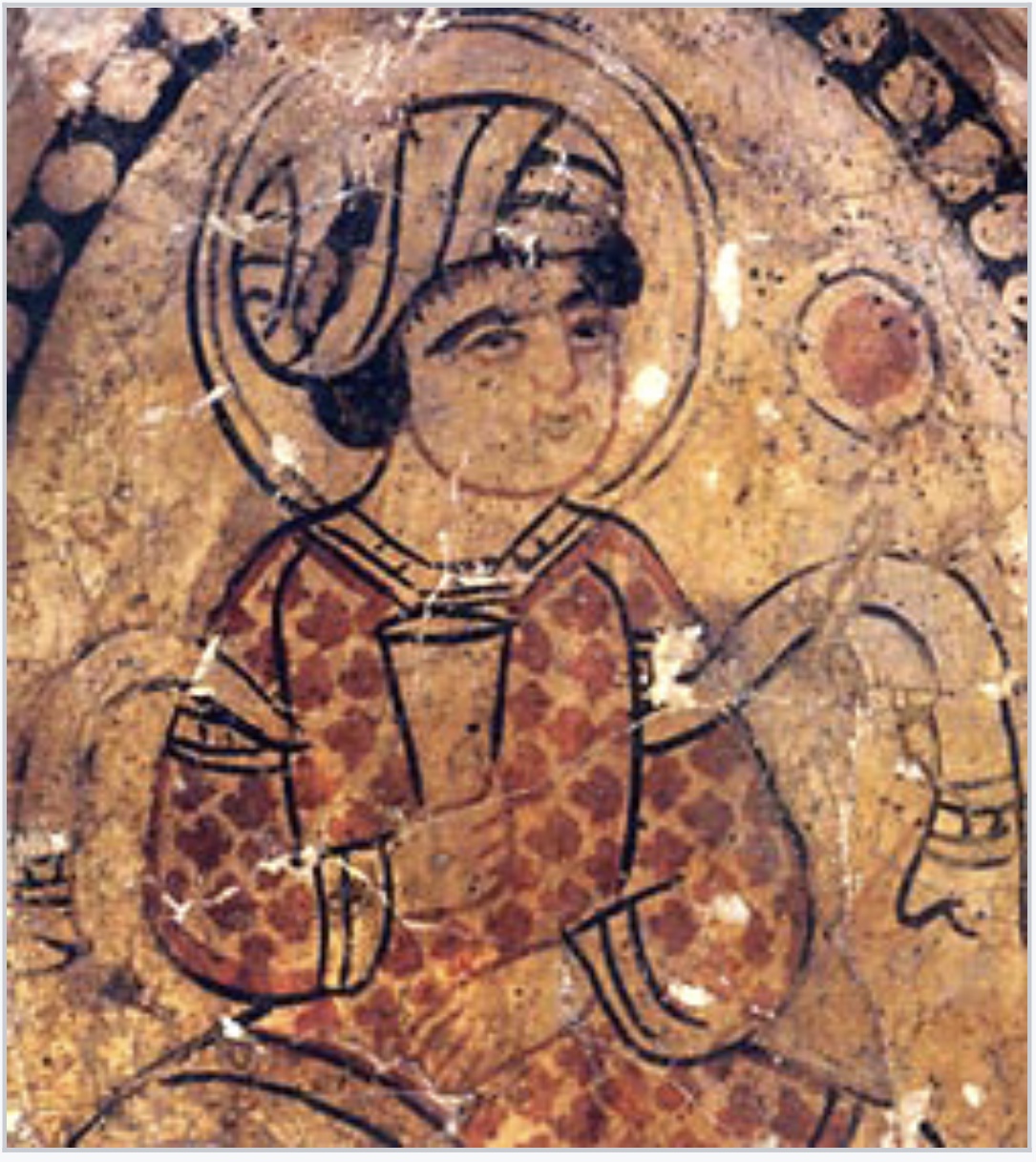
Al-Hakim
*
"Al-Hakim bi-Amr Allah on Wikipedia"
https://en.wikipedia.org/wiki/Al-Hakim_bi-Amr_Allah
The Druze became increasingly secretive after 1043 CE, so that outsiders cannot learn the details of their doctrine. Yet the central tenets might be outlined as follows.
Central Doctrines
(1) Monotheism
God is the supreme and only one.
(2) Reincarnation
When one dies, the soul is immediately reborn in another human body, as there are only a limited number of souls in existence. Unlike other reincarnation beliefs, the soul is reborn in a body of the same sex and within the Druze community. A Druze soul cannot be reborn in a non-Druze body. At the end of the reincarnation cycle, the soul becomes one with the cosmic mind.
Other Doctrines
(1) Prophets
Special respect is given to the prophet Shuaib, who appears frequently in the Qur'an (Shuaib is the prophet of Moses). (Shuaib is also claimed to be the same person as Jethro, the father of Moses' wife.)
Adam, Noah, Abraham, Moses, Jesus, Muhammad, and Ismail are prophets to be respected.
Pythagoras, Plato, Aristotle, and Parmenides are also respected prophets.
(2) Scriptures
The Druze scriptures include the Old Testament, the New Testament, the Quran, etc. In addition, the Druze have their own scriptures.
Other Druze scriptures that are unique to the Druze are the Letters of Wisdom.
The Letters of Wisdom are a compilation of 111 letters written by early leaders compilled in the 14th century, however, they were written to advise believers on spiritual and secular matters and they are not systematic.
*
"Quran on Wikipedia"
https://en.wikipedia.org/wiki/Quran
(3) Mixture of Thoughts
The Druze doctrines are a mixture of influences including Ismailism, Christianity, Gnosticism, Neoplatonism, Zoroastrianism, Buddhism, Hinduism, and Pythagoreanism. The faith is characterized by many esoteric interpretations of scripture.
*
"Pythagoreanism on Wikipedia"
https://en.wikipedia.org/wiki/Pythagoreanism
*
"Neoplatonism on Wikipedia"
https://en.wikipedia.org/wiki/Neoplatonism
(4) Esotericism
The secrecy of doctrines and beliefs includes the practice of concealing one's faith when necessary (taqiyya). This secrecy is intended to protect the Druze faith and has historically led to a discouragement of intermarriage with outsiders, cementing the group as a distinct ethno-religious community.
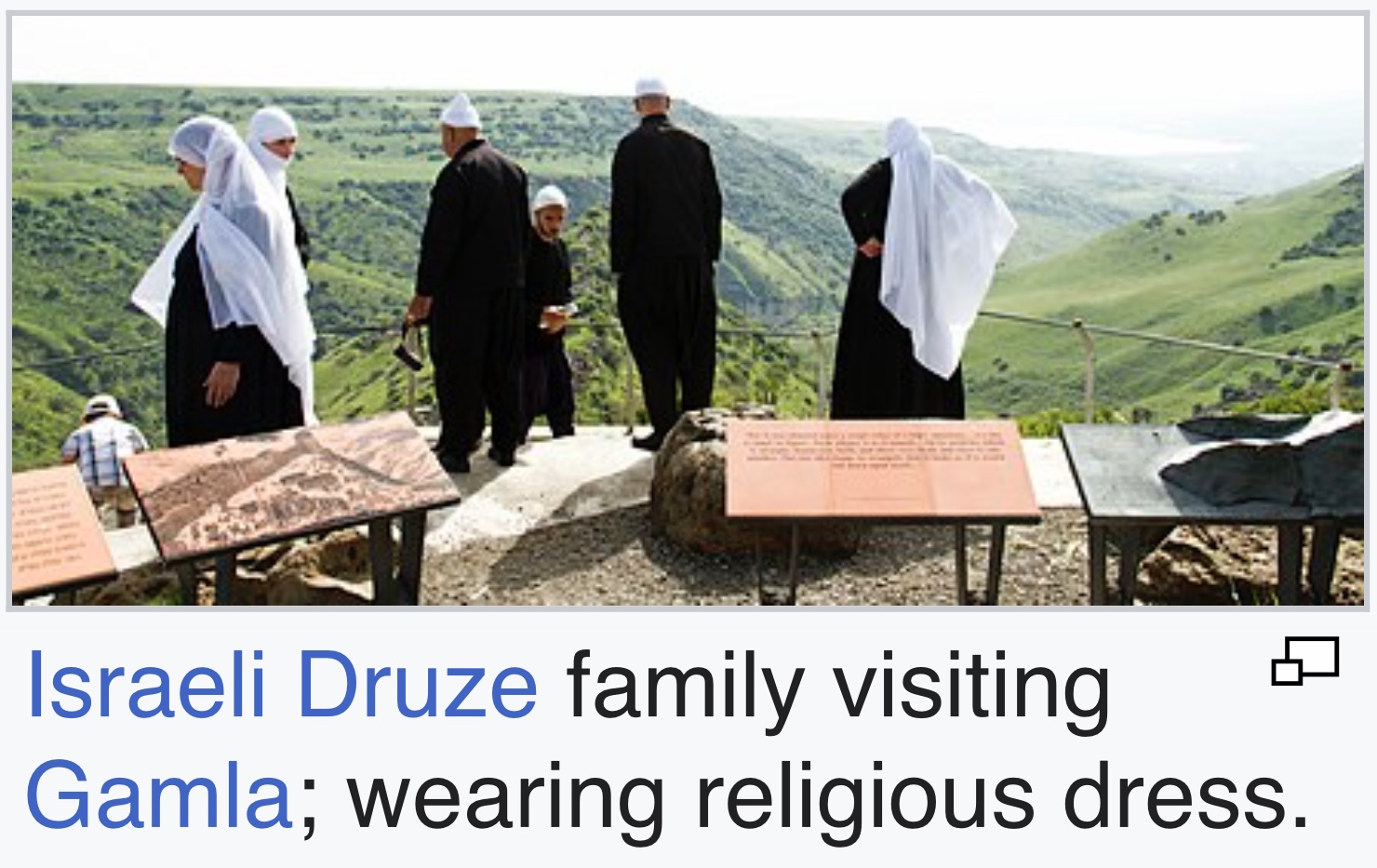
(5) Rituals
They have prayer houses for prayer. Religious meetings (Laylet Al-Jum'a) are held once a week on Thursdays in the assembly hall. (This differs from the Friday mosque services generally practiced by Muslims).
(6) Religious Symbols
The official emblem is the five-colored star (or five-pointed star), with each color representing one of the five cosmic principles that embody the core Druze tenets.

Symbol of the Druze
Other Origin Theories
Although the above theory of Hamza's origin is the most commonly accepted,
alternative theories exist, often linking the Druze to various ancient local groups in the Levant etc.
They may claim that the Druze are related to the ancient English Druids, Freemasonry, builders of
Solomon's Temple, survivors of the Crusades, etc.
(As mentioned later, the Pythagoreans also use a pentagram as a religious symbol, the Pythagoreans and Neoplatonism are also important in Masonic conspiracy theories.)
*
"Druze on Wikipedia"
https://en.wikipedia.org/wiki/Druze
2.4.1.2.2 Theories and Legends about the Knights Templar
2.4.1.2.2.1 Traditional Concept of the Knights Templar and the Holy Grail
According to the traditionally accepted concept, when the Islamic Seljuk Turks expanded to the west and advanced to the Anatolian peninsula (Asia Minor), the Byzantine Empire asked Pope Urban II to remove the Turks. Pope Urban II advocated for the recovery of Jerusalem, which led to the First Crusade. Crusaders recovered Jerusalem in 1099 CE. Subsequently, a French knight, Hugues de Payens, somehow established the Knights Templar in Jerusalem to protect pilgrims in around 1119 CE.
Hugues de Payens and the Knights Templar mostly returned to the Kingdom
of France in 1127 CE. The Knights Templar were officially authorized by the
Roman Catholic Church in 1129 CE.
The Knights Templar were empowered and started to receive a large amount of
financial benefaction from all over Europe.
*
"Crusades on Wikipedia"
https://en.wikipedia.org/wiki/Crusades
*
"Knights Templar on Wikipedia"
https://en.wikipedia.org/wiki/Knights_Templar
On the other hand, the King Arthur legend, despite its British origins, flourished and developed into a literary tradition around 1160 CE in the Kingdom of France.
The Grail narrative was subsequently introduced into this Arthurian literary tradition in the kingdom through Chrétien de Troyes' romance "Perceval, le Conte du Graal" around 1190 CE.
According to the romance, King Arthur's knight Perceval, returning after his expedition, was invited to the Fisher King's castle. The Fisher King had been seriously wounded, crippled, and was spending his days fishing. Perceval saw a procession passing before him during dinner carrying a bleeding lance, candelabras, and finally a beautiful girl carrying a decorated grail or graal. In this case, the grail, or originally graal in Old French, might be a wide bowl rather than a chalice.
(In Old French, graal or gréal means "a cup or bowl of earth, wood, or metal.")
Chrétien de Troyes purportedly extracted the story from a book that was given to him by his patron, Count Philip of Flanders, who joined the Crusades and died during the Crusades in Acre.
Subsequently, Robert de Boron claimed that the Grail was the vessel Jesus used in the
Last Supper. Joseph of Arimathea, who buried Jesus' body after the Crucifixion, used it
to catch Christ's blood afterward, and the Grail was moved
somewhere. (Joseph of Arimathea could be the tin-merchant uncle of the Virgin Mary,
who took young Jesus to Glastonbury.) The quest for the Grail might have then
become a central issue of Christianity; it was called "sangraal" or "sangréal." In Old French, san
graal or san gréal means "the Holy Grail."
*
"Holy Grail on Wikipedia"
https://en.wikipedia.org/wiki/Holy_Grail
*
"Joseph of Arimathea on Wikipedia"
https://en.wikipedia.org/wiki/Joseph_of_Arimathea
★
"Grail Legends"
http://www.timelessmyths.com/arthurian/keeper.html
Meanwhile, the Crusaders and the Knights Templar in the Middle East were decisively defeated by Muslim forces and lost their strongholds in 1303 CE.
Furthermore, the surviving knights staying in France were mostly arrested by King Philip IV of France in 1307 CE and executed in Paris in 1314 CE.
2.4.1.2.2.2 Prieuré Documents' Knights Templar Holy Blood Grail Theory
Michael Baigent, Richard Leigh, and Henry Lincoln released a book,
The Holy Blood and The Holy Grail, in 1982 CE, examining the Prieuré documents.
The Prieuré documents were anonymous documents, which circulated in France
around 1960 CE, mostly about the Knights Templar and the Holy Grail. The authors
examined the Prieuré documents and presumed that someone intended to partially
reveal critical secrets.
The riddle solving started with an odd story about Rennes-le-Château in southern
France, such as the priest François-Bérenger Saunière's renovation of the church
around 1900 CE, and they presumed a possible association with the Cathars, the Holy Grail,
Troyes, the Knights Templar, the Priory of Sion, Mary Magdalene, the Merovingian dynasty,
the House of Lorraine, the House of Habsburg-Lorraine, and bloodlines.
*
"François-Bérenger Saunière on Wikipedia"
https://en.wikipedia.org/wiki/B%C3%A9renger_Sauni%C3%A8re
*
"House of Lorraine on Wikipedia"
https://en.wikipedia.org/wiki/House_of_Lorraine
For example, in reference to Rennes, Richard Wagner, who composed Wolfram von Eschenbach's King Arthur opera Parsifal, purportedly visited Rennes to seek the Holy Grail.
Aside from that, the Cathar Bertrand de Blanchefort, who was the 6th Grand Master of the
Knights Templar from 1156 CE, donated his dominions near Rennes to the Knights Templar
and started unknown engineering works there. Thus, Rennes, the Cathars, and the Knights
Templar are tied to the Holy Grail.
*
"Parsifal on Wikipedia"
https://en.wikipedia.org/wiki/Parsifal
Consequently, the authors presumed as follows:
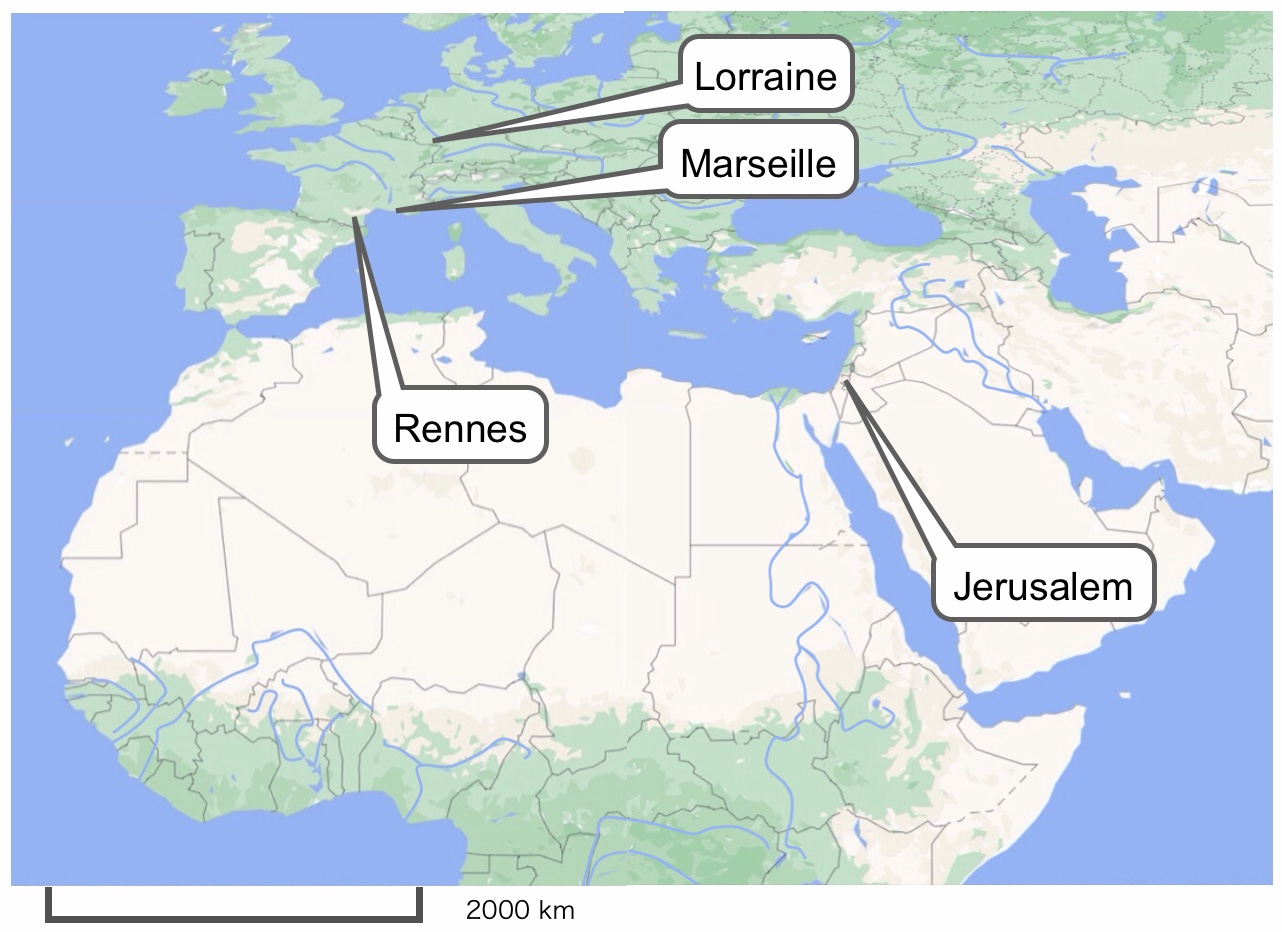
Mary Magdalene gave birth to Jesus' child and moved to Marseille, Gaul (present-day France as of 2020 CE).
Germanic tribes' migration to the southwest started around 400 CE,
and these Germanic tribes entered Gaul.
A descendant of Jesus married into the Germanic Merovech's tribe,
and Merovech's tribe founded the Merovingian dynasty (481 - 751 CE)
of the Franks in 481 CE.
(Jesus' backers (supporters and the successors)
might have secretly preserved
Jesus' descendants and described
their history.)
The Merovingian dynasty was defeated in 751 CE,
but its descendants merged with the French House of Lorraine.
*Attribution:
https://www.atlist.com/showcase/world-map-with-no-labels
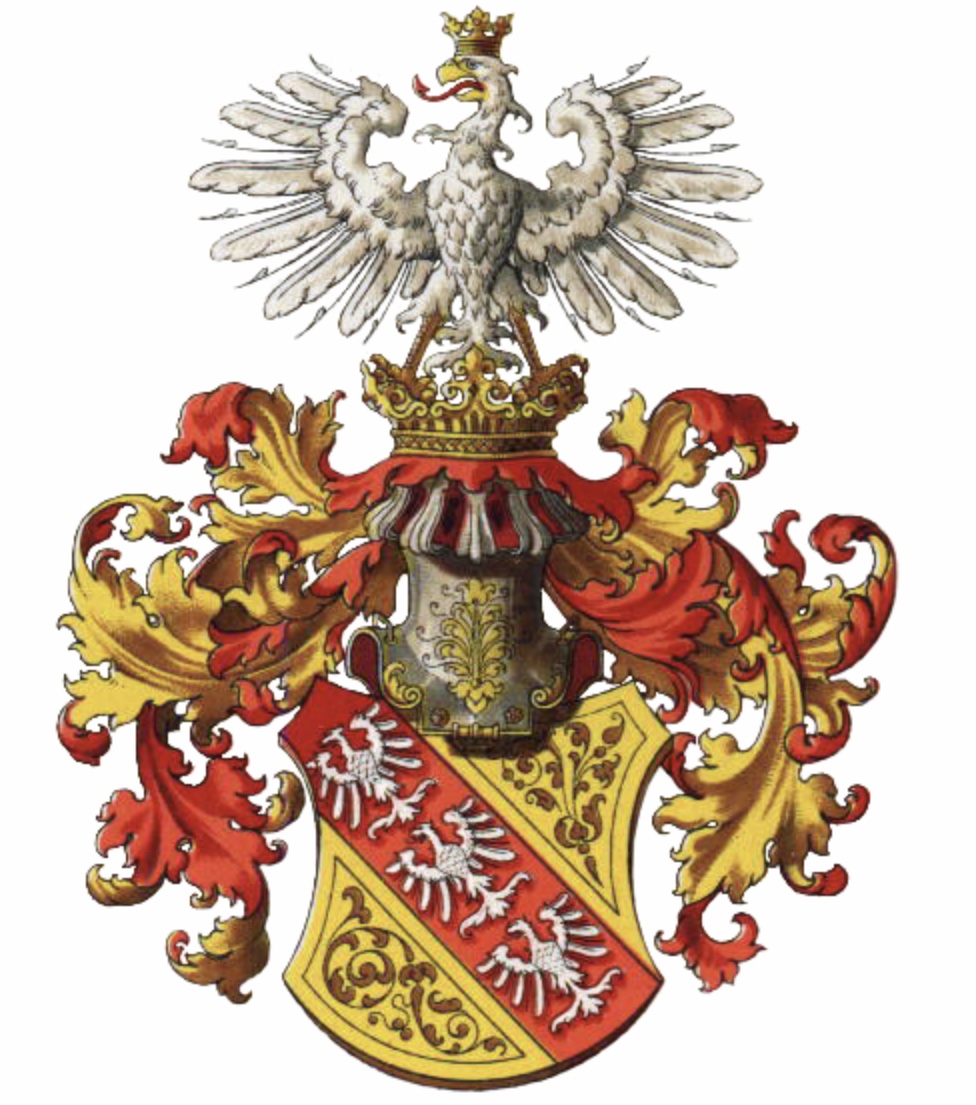
Original Coat of Arms of the House of Lorraine
*Attribution:
https://en.wikipedia.org/wiki/File:Coat_of_arms_of_the_House_of_Lorraine.png
*Other than that, a small church dedicated to Mary Magdalene was created in
Rennes (south of France) in 1059 CE. (The church was later renovated around 1900 CE.)
*
"Rennes Church"
http://www.bibliotecapleyades.net/merovingians/merovingios_renneschateau03_02.htm"
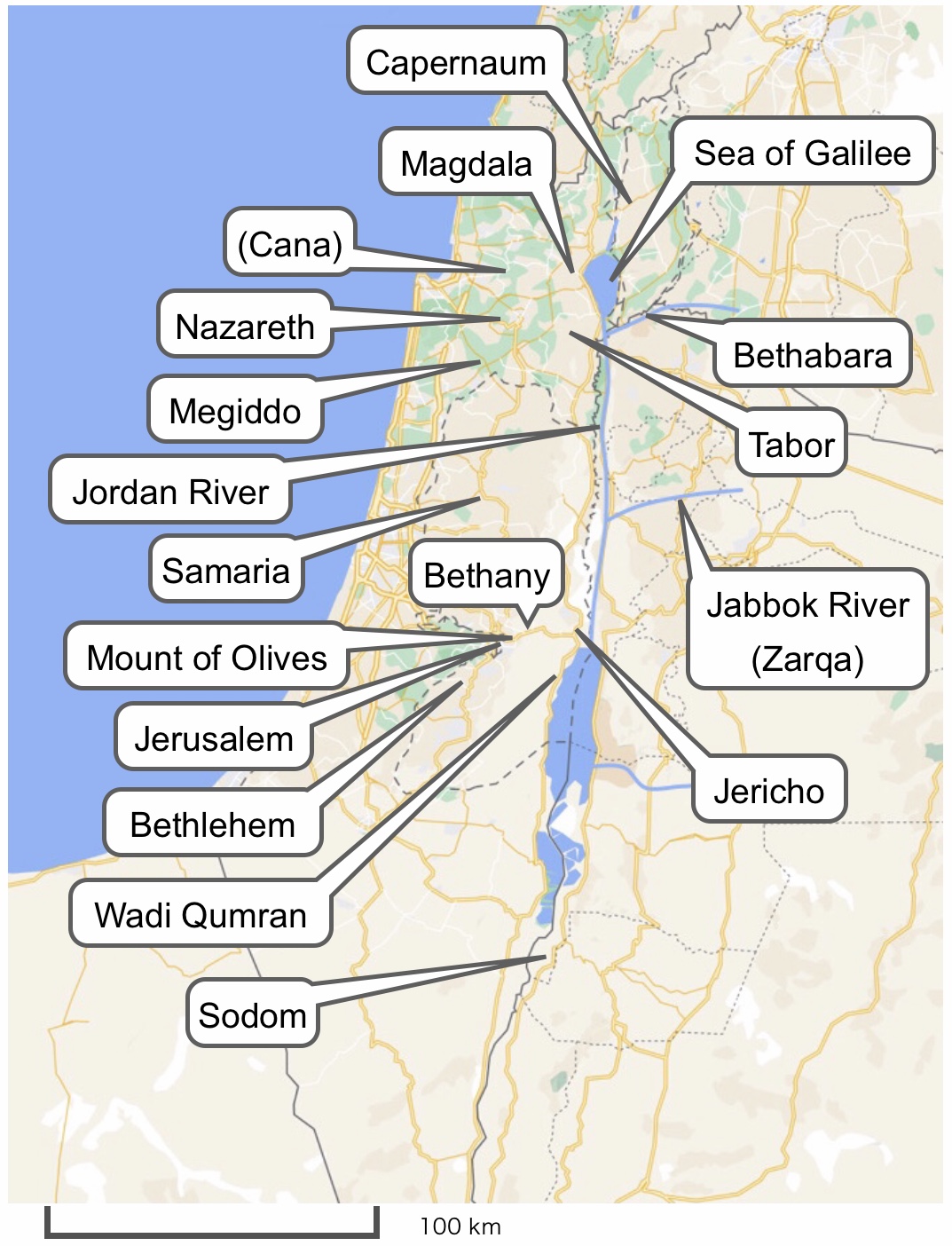
Regarding Mary Magdalene's lineage (or descendants), the authors cite some verses
supporting the close association between Jesus and Mary Magdalene, while the
identity of "the disciple whom Jesus loved" is controversial.
*Attribution:
https://www.atlist.com/showcase/world-map-with-no-labels
A degraded woman served Jesus, washing his feet with her tears and hair
and purifying his feet by applying fragrant oil, and her unhealthy/fallen situation was
recovered by Jesus in Galilee.
*"Then one of the Pharisees asked Him to eat with him. And He went to the
Pharisee’s house, and sat down to eat. And behold,
a woman in the city who was a sinner, when she knew that
Jesus sat at the table in the Pharisee’s house,
brought an alabaster flask of fragrant oil, and stood at His feet behind Him weeping;
and she began to wash His feet with her tears, and wiped them
with the hair of her head; and she kissed His feet and anointed them
with the fragrant oil. Now when the Pharisee who had invited Him saw this,
he spoke to himself, saying, 'This Man, if He were a prophet,
would know who and what manner of woman this is who is touching Him,
for she is a sinner'" (Luk 7:36-39).
*"Then He turned to the woman and said to Simon, 'Do you see this woman?
I entered your house; you gave Me no water for My feet,
but she has washed My feet with her tears and wiped them with the
hair of her head. You gave Me no kiss, but this woman has not
ceased to kiss My feet since the time I came in.
You did not anoint My head with oil, but this woman has anointed My
feet with fragrant oil. Therefore I say to you, her sins, which are many,
are forgiven, for she loved much. But to whom little is forgiven,
the same loves little.' Then He said to her, 'Your sins are forgiven'" (Luk 7:44-48).
Subsequently, a woman called Magdalene, who was saved by Jesus,
was supporting Jesus in Galilee. Then some schools including the authors presume that
the woman, who washed Jesus' feet with her hair and purified his feet applying fragrant oil,
was Mary Magdalene.
*"Now it came to pass, afterward, that He went through every city and
village, preaching and bringing the glad tidings of the kingdom of God.
And the twelve were with Him, and certain women who had been
healed of evil spirits and infirmities—Mary called Magdalene,
out of whom had come seven demons, and Joanna the wife of Chuza,
Herod’s steward, and Susanna, and many others who provided for
Him from their substance" (Luk 8:1-3).
Aside from that, Jesus was somehow familiar with Lazarus and his sisters in Bethany,
Gospel of John, which was purportedly written by a disciple whom Jesus loved,
somehow exclusively tells Lazarus' resurrection.
★
Disciple whom Jesus Loved on Wikipedia"
https://en.wikipedia.org/wiki/Disciple_whom_Jesus_loved
*"Now a certain man was sick, Lazarus of Bethany,
the town of Mary and her sister Martha.
It was that Mary who anointed the Lord with fragrant
oil and wiped His feet with her hair, whose brother
Lazarus was sick. Therefore the sisters sent to Him,
saying, 'Lord, behold, he whom You love is sick.'
When Jesus heard that, He said,
'This sickness is not unto death, but for the glory of God,
that the Son of God may be glorified through it.'
Now Jesus loved Martha and her sister and Lazarus.
So, when He heard that he was sick, He stayed two more
days in the place where He was.
Then after this He said to the disciples,
'Let us go to Judea again.' The disciples said to Him,
'Rabbi, lately the Jews sought to stone You, and are
You going there again?' Jesus answered,
'Are there not twelve hours in the day? If anyone walks in the
day, he does not stumble, because he sees the light of this world.
But if one walks in the night, he stumbles, because the light is
not in him.'
These things He said, and after that He said to them,
'Our friend Lazarus sleeps, but I go that I may wake him up.'
Then His disciples said,
'Lord, if he sleeps he will get well.'
However, Jesus spoke of his death, but they thought that He
was speaking about taking rest in sleep.
Then Jesus said to them plainly,
'Lazarus is dead. And I am glad for your sakes that I was
not there, that you may believe. Nevertheless let us go to him.'
Then Thomas, who is called the Twin, said to his fellow disciples,
'Let us also go, that we may die with Him.'
So when Jesus came, He found that he had already been in
the tomb four days. Now Bethany was near Jerusalem,
about two miles away. And many of the Jews had joined the
women around Martha and Mary, to comfort them concerning
their brother. Now Martha, as soon as she heard that Jesus
was coming, went and met Him, but Mary was sitting in the house.
Now Martha said to Jesus, 'Lord, if You had been here, my
brother would not have died. But even now I know that whatever
You ask of God, God will give You.'
Jesus said to her, 'Your brother will rise again.'
Martha said to Him,
'I know that he will rise again in the resurrection at the last day.'
Jesus said to her,
'I am the resurrection and the life. He who believes in Me,
though he may die, he shall live.
And whoever lives and believes in Me shall never die.
Do you believe this?' She said to Him,
'Yes, Lord, I believe that You are the Christ, the Son of God,
who is to come into the world.'
And when she had said these things, she went her way and
secretly called Mary her sister, saying,
'The Teacher has come and is calling for you.'
As soon as she heard that, she arose quickly and came to Him.
Now Jesus had not yet come into the town,
but was in the place where Martha met Him. Then the
Jews who were with her in the house, and comforting her,
when they saw that Mary rose up quickly and went out, followed
her, saying, 'She is going to the tomb to weep there.'
Then, when Mary came where Jesus was, and saw Him, she fell
down at His feet, saying to Him,
'Lord, if You had been here, my brother would not have died.'
Therefore, when Jesus saw her weeping, and the Jews who came
with her weeping, He groaned in the spirit and was troubled.
And He said, 'Where have you laid him?'
They said to Him, 'Lord, come and see.'
Jesus wept. Then the Jews said, 'See how He loved him!'
And some of them said,
'Could not this Man, who opened the eyes of the blind, also have
kept this man from dying?'
Then Jesus, again groaning in Himself, came to the tomb.
It was a cave, and a stone lay against it. Jesus said,
'Take away the stone.' Martha, the sister of him who was dead,
said to Him, 'Lord, by this time there is a stench, for he has been
dead four days.' Jesus said to her,
'Did I not say to you that if you would believe you would see
the glory of God?'
Then they took away the stone from the place where the
dead man was lying. And Jesus lifted up His eyes and said,
'Father, I thank You that You have heard Me.
And I know that You always hear Me, but because of the people
who are standing by I said this, that they may believe that You
sent Me.'
Now when He had said these things, He cried with a loud voice,
'Lazarus, come forth!'
And he who had died came out bound hand and foot with
graveclothes, and his face was wrapped with a cloth.
Jesus said to them, 'Loose him, and let him go'" (Joh 11:1-44).
Subsequently, Jesus visited Lazarus' house in Bethany. His sister Mary was there,
and she purified Jesus' feet with fragrant oil and her hair, just like the woman in Galilee.
For this reason, some schools presume that she is identical with the woman who purified
Jesus' feet with fragrant oil and her hair at the Pharisee's house in Galilee, and with the
woman called Magdalene who supported Jesus in Galilee.
*"Then, six days before the Passover, Jesus came to Bethany,
where Lazarus was who had been dead, whom He had raised from the
dead. There they made Him a supper; and Martha served, but Lazarus
was one of those who sat at the table with Him. Then Mary took a
pound of very costly oil of spikenard, anointed the feet of Jesus, and
wiped His feet with her hair. And the house was filled with the fragrance
of the oil" (Joh 12:1-3).
The Gospel of Matthew tells a similar story, although Simon the Leper could be the
father of Lazarus and his sisters.
*"And when Jesus was in Bethany at the house of Simon
the leper, a woman came to Him having an alabaster flask
of very costly fragrant oil, and she poured it on His head
as He sat at the table" (Mat 26:6-7).
According to the Gospel of John, Jesus told the disciples about the betrayer,
and the disciple who was loved by Jesus secretly asked him about the betrayer, leaning
back on Jesus' breast.
*"When Jesus had said these things, He was troubled in spirit,
and testified and said, 'Most assuredly, I say to you, one of you will
betray Me.'
Then the disciples looked at one another, perplexed about whom
He spoke. Now there was leaning on Jesus’ bosom one of His disciples,
whom Jesus loved. Simon Peter therefore motioned to him to ask
who it was of whom He spoke. Then, leaning back on Jesus’ breast,
he said to Him, 'Lord, who is it?' Jesus answered,
'It is he to whom I shall give a piece of bread when I have dipped it.'
And having dipped the bread, He gave it to Judas Iscariot,
the son of Simon" (Joh 13:21-26).
Referring to these verses, for example, Ghirlandaio painted The Last Supper in 1480 CE,
where the beloved disciple leans back on Jesus' breast.
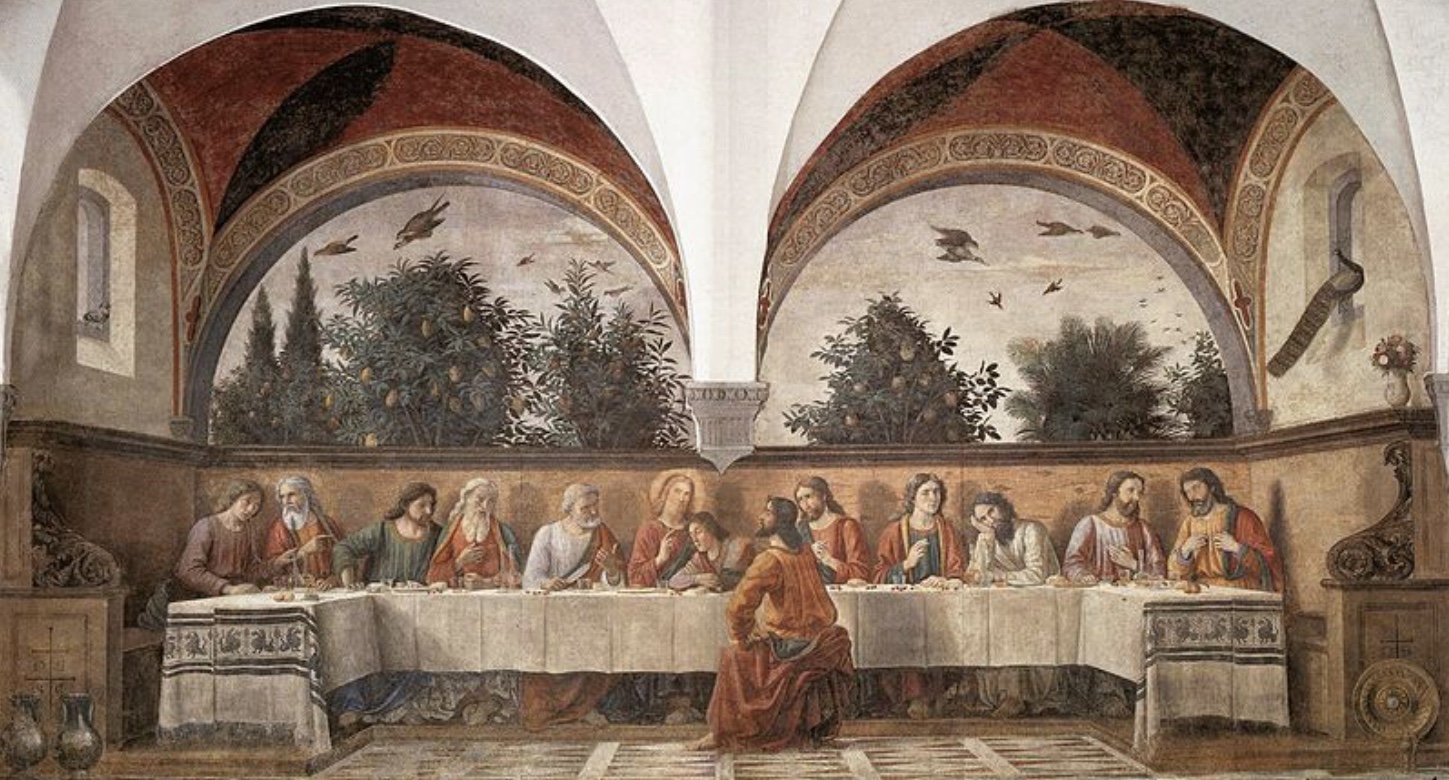
Ghirlandaio's Last Supper
*Attribution:
https://en.wikipedia.org/wiki/File:Domenico_ghirlandaio,_cenacolo_di_ognissanti_01.jpg
In contrast, Leonardo da Vinci didn't explicitly paint the leaning disciple in The Last Supper in 1498 CE.
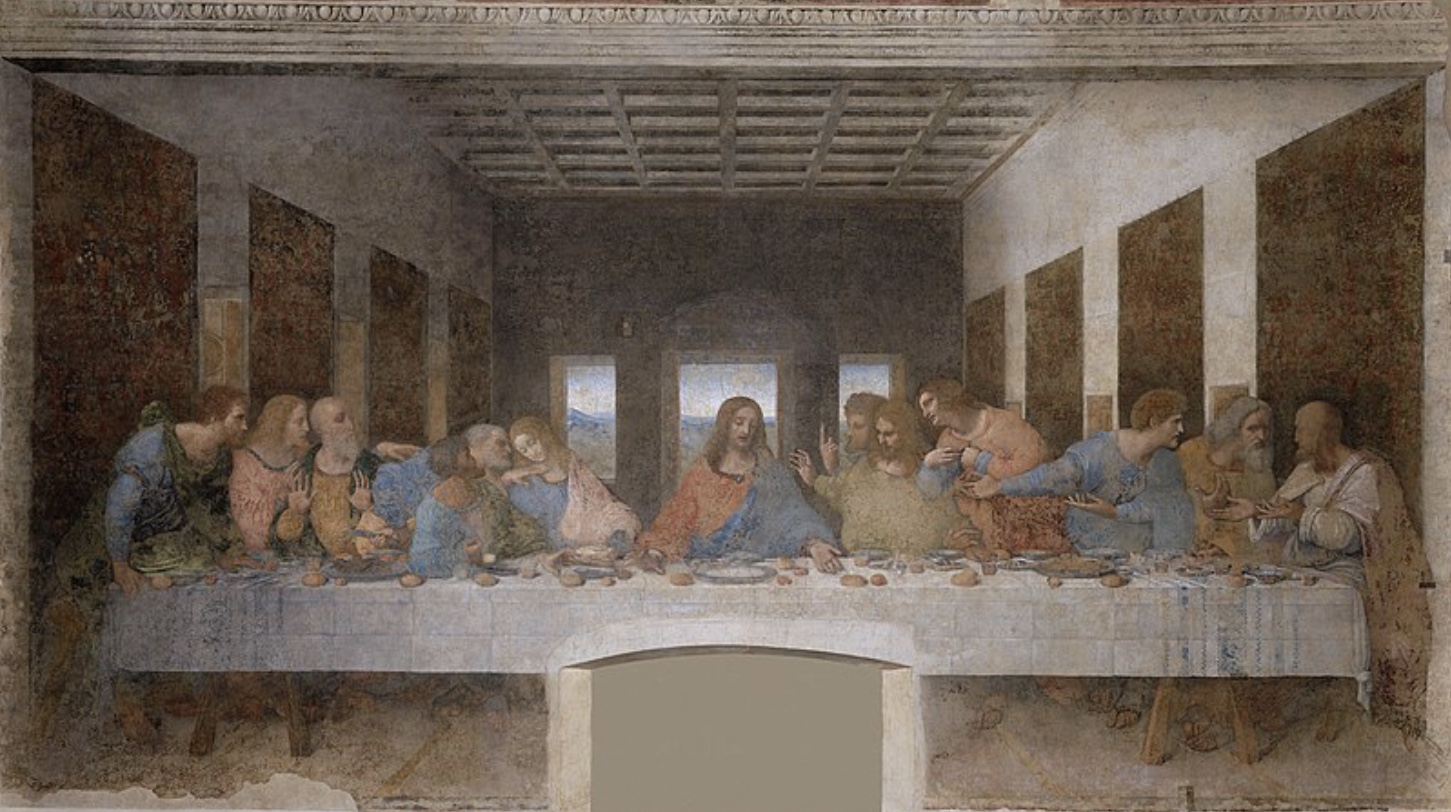
The Last Supper by Leonardo da Vinci
*Attribution:
https://en.wikipedia.org/wiki/File:%C3%9Altima_Cena_-_Da_Vinci_5.jpg
However, when the neighboring figure is moved, a woman leaning back on Jesus' breast becomes visible.
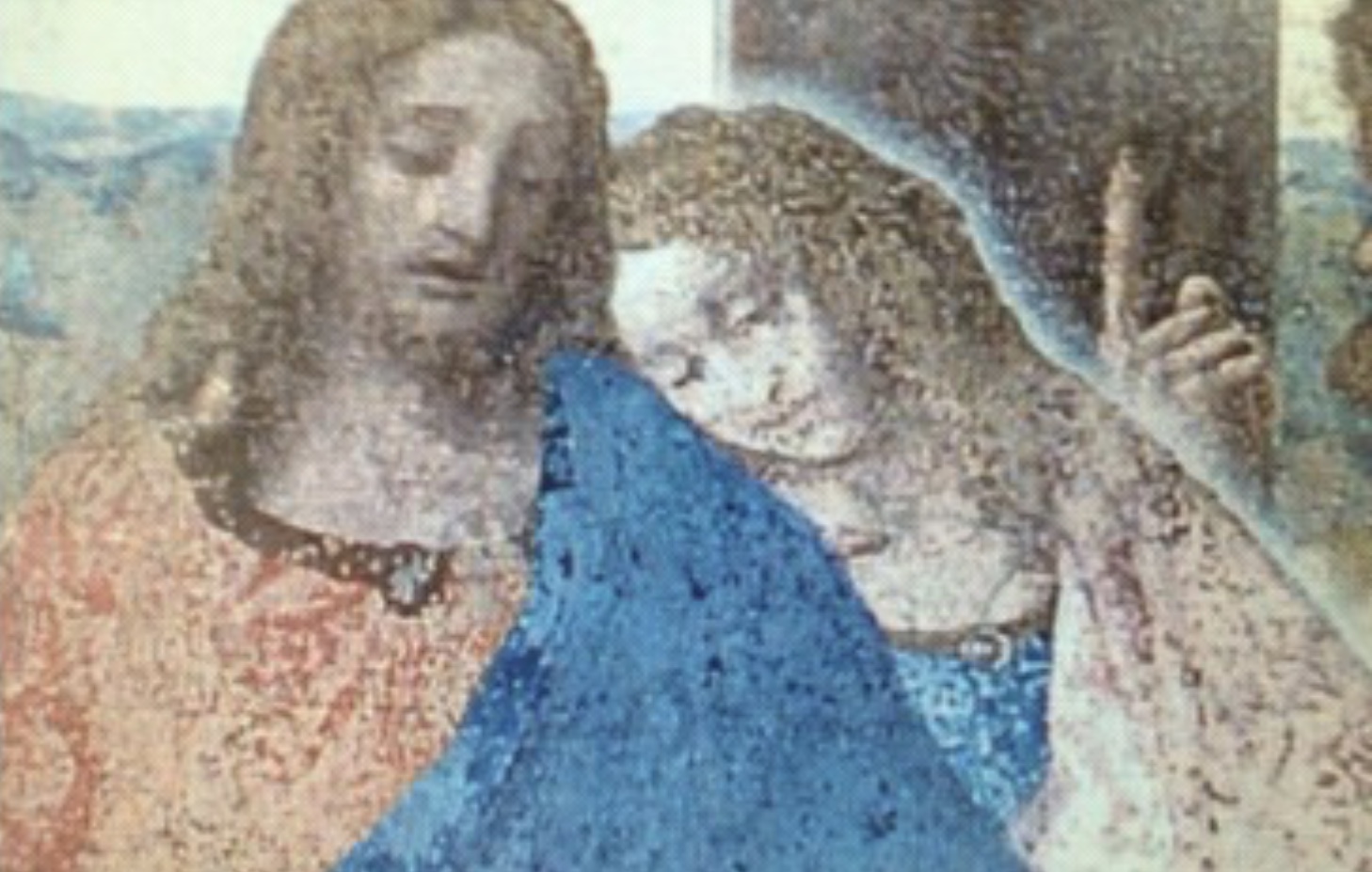
Thus, Leonardo da Vinci assumes that the disciple whom Peter asked was Mary Magdalene.
However, in reference to Mary Magdalene's visit to the tomb, the Gospel of John refers
to "the other disciple, whom Jesus loved," who was with Peter. According to this translation, it
means that there was a male disciple (not Mary Magdalene) whom Jesus loved.
*"Now the first day of the week Mary Magdalene went to the tomb early,
while it was still dark, and saw that the stone had been taken away
from the tomb. Then she ran and came to Simon Peter,
and to
the other disciple, whom Jesus loved, and said to
them, 'They have taken away the Lord out of the tomb,
and we do not know where they have laid Him.'
Peter therefore went out, and the other disciple,
and were going to the tomb" (Joh 20:1-3).
The person whom the resurrected Jesus met first was Mary Magdalene.
This supports Mary Magdalene's close association with Jesus.
*"Then the disciples went away again to their own homes.
But Mary stood outside by the tomb weeping, and as she
wept she stooped down and looked into the tomb.
And she saw two angels in white sitting, one at the head
and the other at the feet, where the body of Jesus had lain.
Then they said to her, 'Woman, why are you weeping?'
She said to them, 'Because they have taken away my Lord,
and I do not know where they have laid Him.'
Now when she had said this, she turned around and saw
Jesus standing there, and did not know that it was Jesus.
Jesus said to her, 'Woman, why are you weeping?
Whom are you seeking?' She, supposing Him to be the
gardener, said to Him, 'Sir, if You have carried Him away,
tell me where You have laid Him, and I will take Him away.'
Jesus said to her, 'Mary!' She turned and said to Him, 'Rabboni!'
(which is to say, Teacher). Jesus said to her,
'Do not cling to Me, for I have not yet ascended to My Father;
but go to My brethren and say to them, "I am ascending to My
Father and your Father, and to My God and your God."'
Mary Magdalene came and told the disciples that she had seen
the Lord,
and that He had spoken these things to her" (Joh 20:10-18).
The end of John's Gospel refers to the resurrected Jesus' prophecy about
Peter's martyrdom, and mentions the disciple whom Jesus loved was standing near
Peter at that time. It also states that John's Gospel was written by the disciple
whom Jesus loved, who some presume to be Lazarus.
*"'Most assuredly, I say to you, when you were younger,
you girded yourself and walked where you wished; but when
you are old, you will stretch out your hands, and another
will gird you and carry you where you do not wish.'
This He spoke, signifying by what death he would glorify God.
And when He had spoken this, He said to him, 'Follow Me.'
Then Peter, turning around, saw the disciple whom Jesus loved
following, who also had leaned on His breast at the supper,
and said, 'Lord, who is the one who betrays You?'
Peter, seeing him, said to Jesus, 'But Lord, what about this man?'
Jesus said to him, 'If I will that he remain till I come, what is that to you?
You follow Me.'
Then this saying went out among the brethren that this disciple
would not die. Yet Jesus did not say to him that he would not die, but,
'If I will that he remain till I come, what is that to you?'
This is the disciple who testifies of these things, and wrote these things;
and we know that his testimony is true.
And there are also many other things that Jesus did, which if they
were written one by one, I suppose that even the world itself could
not contain the books that would be written. Amen" (Joh 21:18-25).
According to the Gospel of Mary, the disciples discussed Jesus' teachings after his ascension, as follows:
*"Peter said to Mary, 'Sister we know that the Savior loved
you more than the rest of woman.
Tell us the words of the Savior which you remember
which you know, but we do not, nor have we heard them.'
Mary answered and said, 'What is hidden from you I will
proclaim to you'" (Gospel of Mary 5:5-7).
*
"Gospel of Mary on Wikipedia"
https://en.wikipedia.org/wiki/Gospel_of_Mary
*
"Gospel of Mary Magdalene Library"
http://gnosis.org/library/marygosp.htm
Gospel of Philip states as follows,
while Gospel of Philip is quite ideological rather than a biography.
*36. "There were three Mariams who walked with the
Lord at all times: his mother and [his] sister and (the)
Magdalene—this one who is called his mate.
Thus his (true) Mother and Sister and Mate is (also called)
'Mariam'" (Gospel of Philip 36).
*59. "The wisdom which (humans) call barren is the
Mother of the Angels. And the Mate of the [Christ] is
Mariam the Magdalene. The [Lord loved] Mariam more than
[all the (other)] Disciples, [and he] kissed her often on her
[mouth.] The other [women] saw his loving Mariam, they
say to him: Why do thou love [her] more than all of us?
|| The Savior replied, he says to them: Why do I not love
you as (I do) her?" (Gospel of Philip 59).
*
"Gospel of Philip on Wikipedia"
https://en.wikipedia.org/wiki/Gospel_of_Philip
*
"Gospel of Philip"
https://web.archive.org/web/20050210032405/http://www.metalog.org/files/philip.html
Subsequently, the descendants, such as Godfrey of Bouillon, joined the
First Crusade (to establish a kingdom for Jesus' descendants in Jerusalem), recovered
Jerusalem, and became the first ruler of Jerusalem, supposedly with the mediation of
the secret backers. He founded the Priory of Sion in Jerusalem in 1099 CE.
*On the other hand, it is said that an Amalfitan merchant (Amalfi, a coastal town
on the south Italian Peninsula) established a hospital dedicated to Saint John the
Baptist in Jerusalem in 1023 CE. The related persons dedicated to Saint John the
Baptist then became the Knights Hospitaller (the Order of the Knights of Saint John) in
Jerusalem in 1099 CE.
Baldwin I (Godfery of Bouillon's younger brother)
became the king of Jerusalem in 1100 CE allying with Godfery.
*
"Crusades on Wikipedia"
https://en.wikipedia.org/?title=Crusades
*
"The Holy Blood and the Holy Grail on Wikipedia"
https://en.wikipedia.org/wiki/The_Holy_Blood_and_the_Holy_Grail
*
"Priory of Sion on Wikipedia"
https://en.wikipedia.org/wiki/Priory_of_Sion
*
"Merovingian Dynasty on Wikipedia"
https://en.wikipedia.org/wiki/Merovingian_dynasty
*
"Godfrey of Bouillon on Wikipedia"
https://en.wikipedia.org/wiki/Godfrey_of_Bouillon
*
"Knights Hospitaller on Wikipedia"
https://en.wikipedia.org/wiki/Knights_Hospitaller
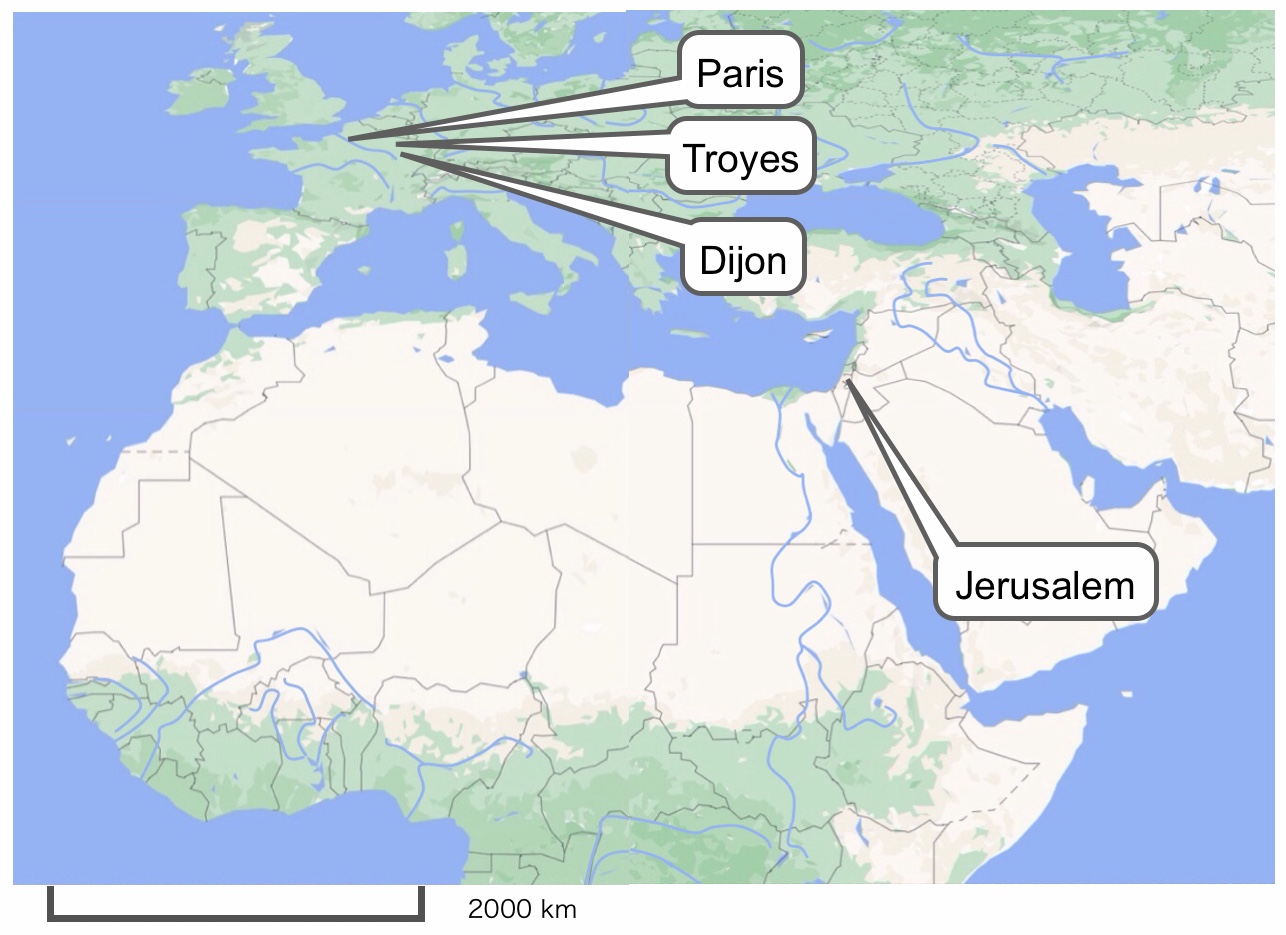
*On the other hand, Dijon was a town in east-central France (200 km to the southeast of
Paris), located within the Duchy of Burgundy. Saint Bernard (born in 1090 CE near Dijon)
joined a Christian sect near Dijon to become a monk in 1113 CE. He established an abbey
near Dijon in 1116 CE, and he became an influential and noble abbot.
*Attribution:
https://www.atlist.com/showcase/world-map-with-no-labels
*
"Bernard of Clairvaux on Wikipedia"
https://en.wikipedia.org/wiki/Bernard_of_Clairvaux
Other than that, it is said that the Knights Templar, consisting of nine knights, was founded by Hugues de Payens in Jerusalem in 1118 CE under the pretext of protecting pilgrims.
However, records of their protecting activities are rarely seen. Consequently, their true
purpose may have been the revival of the Jesus bloodline in Jerusalem, in addition to
searching for secrets such as the Sangréal texts (Grail texts) to authorize the legitimacy of the Merovingian dynasty, and searching for other secrets.
The origin of Hugues de Payens is unclear, although he came from Troyes in Champagne, located 120 km to the east-southeast of Paris.
King Baldwin II granted the Knights Templar permission to live in the sacred area of the Temple on Mount Moriah in 1118 CE. (The location of Mount Moriah is unclear, though it may be the Temple Mount or Mount Zion.)
*Regarding the Temple Mount:
The First Temple (Solomon's Temple), which was made of wood, was possibly created on the Temple Mount around 963 (or 832) BCE and was destroyed around 587 (or 422) BCE by the Neo-Babylonian ruler Nebuchadnezzar II. However, the accurate location of the First Temple and its dates are unclear.
The Second Temple was built on the Temple Mount around 516 (or 350) BCE by returnees from the Babylonian Captivity. It was renovated by King Herod around 20 BCE and subsequently called Herod's Temple. Herod's Temple (the Second Temple) was destroyed in 70 CE.
The Dome of the Rock was built on the Temple Mount in 691 CE, and the Al-Aqsa Mosque was first constructed on the site in 705 CE by the Islamic power. Although damaged by earthquakes, it was rebuilt in 1035 CE.
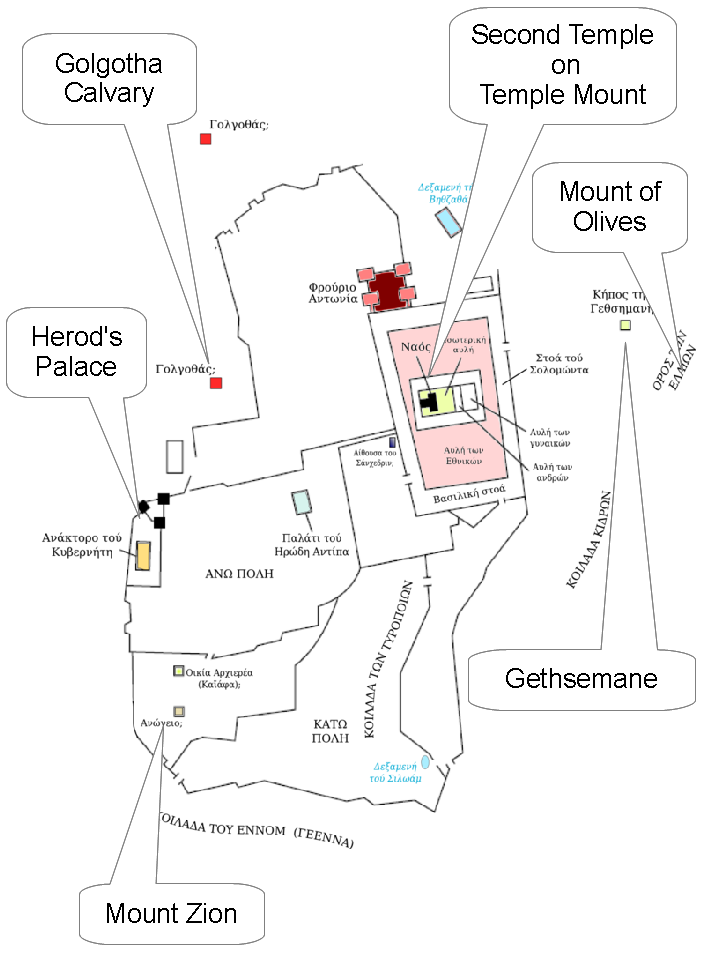

Jerusalem in Jesus Era
*Attribution:
http://commons.wikimedia.org/wiki/File:Jerusalem_at_Jesus_time_EL.png
*
"Knights Templar on Wikipedia"
https://en.wikipedia.org/wiki/Knights_Templar
*
"Knights Templar Timeline"
http://www.medieval-life-and-times.info/crusades/knights-templar-timeline.htm
*
"Hugues de Payens on Wikipedia"
https://en.wikipedia.org/wiki/Hugues_de_Payens
*
"Third Temple on Wikipedia"
https://en.wikipedia.org/wiki/Third_Temple
*
"Solomon's Temple on Wikipedia"
https://en.wikipedia.org/wiki/Solomon%27s_Temple
*
"Second Temple on Wikipedia"
https://en.wikipedia.org/wiki/Second_Temple
*
"Dome of the Rock on Wikipedia"
https://en.wikipedia.org/wiki/Dome_of_the_Rock
*
"Al Aqsa Mosque on Wikipedia" https://en.wikipedia.org/wiki/Al-Aqsa_Mosque
Hugues de Payens and the Knights Templar mostly returned to the Kingdom of France in 1127 CE.
The Christian council in Troyes was convened by Bernard (Saint Bernard), and Bernard
enthusiastically endorsed the Knights Templar in 1128 CE.
The Knights Templar may have discovered something extremely valuable in Jerusalem in 1127 CE.
The Knights Templar was officially authorized by the Roman Catholic Church in 1129 CE.
The Knights Templar were empowered and started to receive a large amount of financial
benefaction from all over Europe.
*
"Nights Templar Presents Jesus' Truths"
http://en.chartressecrets.org/templars/templar_present_truth.htm
Godfrey of Bouillon, Hugues de Payens, Bernard, and Montbard might all belong to the Jesus bloodline.
If so, the Sangraal (Holy Grail) story may have been fabricated to implicitly suggest the existence of the Jesus bloodline. Furthermore, the name "Sangraal" may derive its meaning from two interpretations related to the bloodline: (1) The first meaning could be "San Graal," or Holy Grail, specifically referring to Mary Magdalene's womb, which received Jesus' sperm. (2 ) The second meaning could be "Sang Raal," or Royal Blood, specifically signifying the Jesus bloodline.
*In 1146 CE, the Knights Templar was granted the Red Cross, representing martyrdom, by Pope Eugene III.
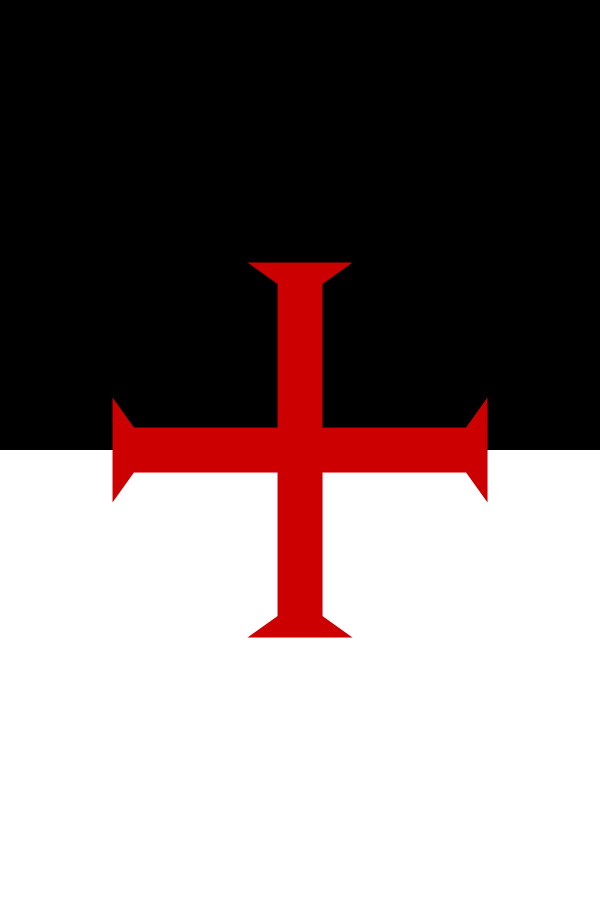
One of the Reported Flags of the Knights Templar
*Attribution:
https://en.wikipedia.org/wiki/File:Templar_Flag_6.svg
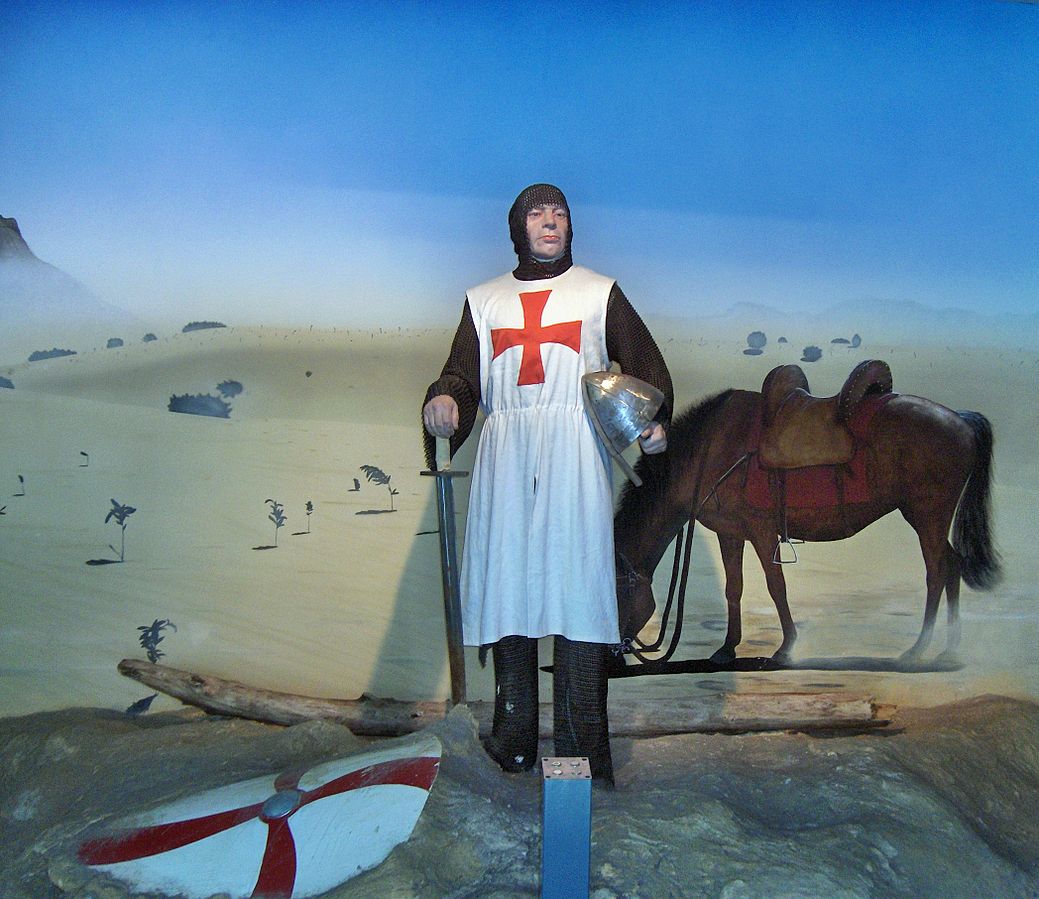
Representation of a Knights Templar
*Attribution:
https://en.wikipedia.org/wiki/File:HPIM3597.JPG
Andre de Montbard (born in 1097 CE) became the
5th Grand Master of the Knights Templar in 1153 CE.
(Though born in 1097 CE, Andre was Bernard's uncle.)
Saint Bernard promoted the Knights Templar but subsequently required nobility and closed membership to maintain the Order's noble status. Thus, the Knights Templar, authorized likely due to the secret discovery in Jerusalem, grew in power and wealth.
Subsequently, the army and the King of Jerusalem were defeated by the Turkish army in 1187 CE (at the Battle of Hattin), which led to the fall of Jerusalem. Consequently, many knights of the Knights Templar captured at that time were executed.
Despite this defeat, the coastal city of Acre, located west of the Sea of Galilee, was recaptured by the Crusaders, the Knights Templar, and the Order of the Knights of Saint John in 1191 CE.
2.4.1.2.2.3 Ishtar's Instruction
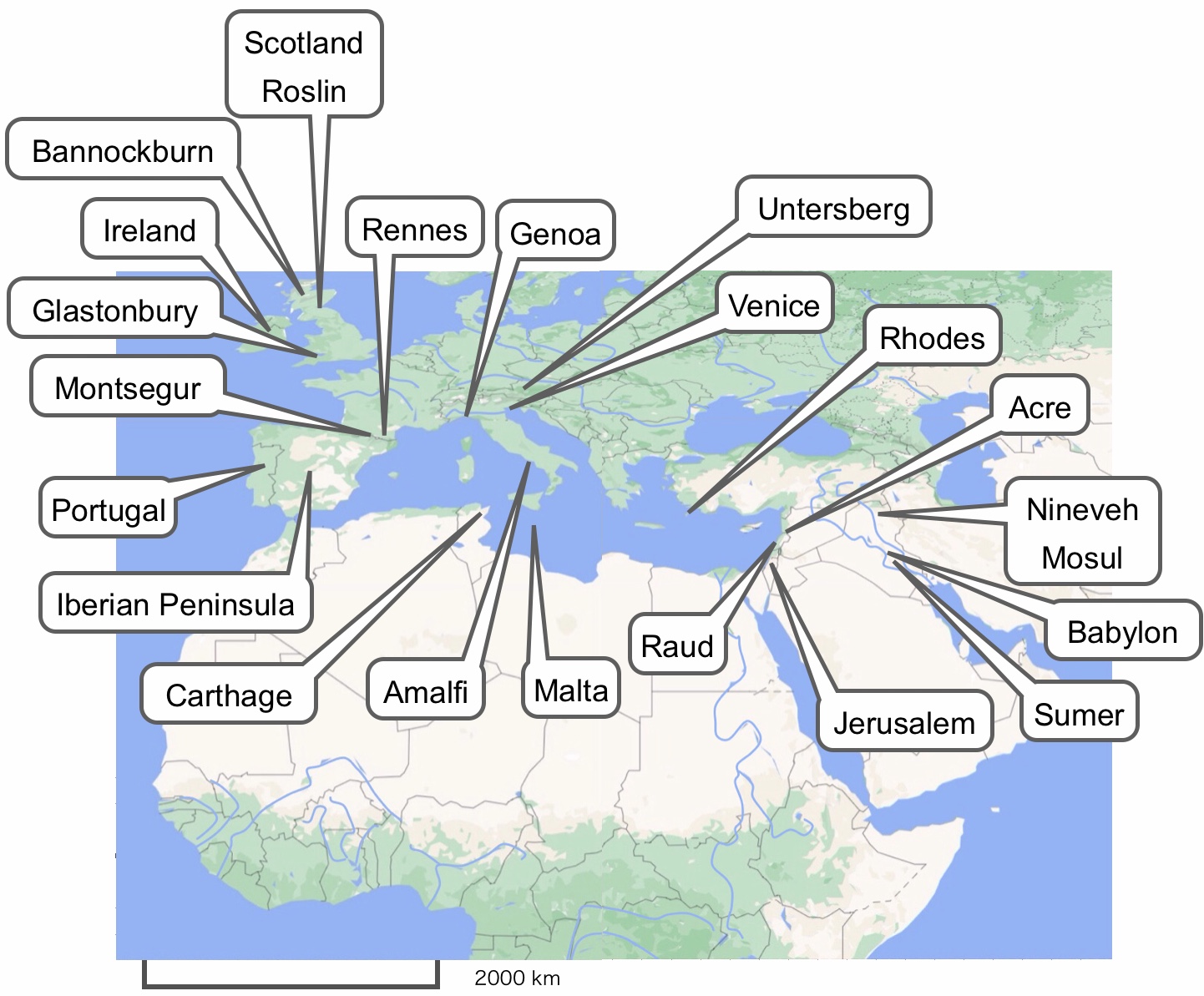
On the other hand, according to the later secret society of the Templars, Ordo Bucintoro (founded in 1512 CE) mentioned below, the Templar Komtur (commander of a squad), Hubertus Koch, was returning with a small party from the Crusades, passing through Mesopotamia in 1220 CE (supposedly after his expedition to the East).
They purportedly encountered an apparition of the beautiful Babylonian goddess Ishtar (Isais, or Asherah) near the old city of Nineveh (present-day Mosul, Iraq as of 2020 CE).
(The Babylonian goddess Ishtar corresponds to the Sumerian goddess Inanna. According to Ancient Egyptian Myths, Ishtar (Isais) is purportedly the first child of the goddess Isis and the god Set. Furthermore, according to Ancient Egyptian Myths, the god Osiris, the goddess Isis, and the god Set are all children of the god Geb and the goddess Nut. The god Horus is a son of the god Osiris and the goddess Isis.)
They purportedly received some instructions and later some gifts.
She gave them an instruction that they should retire to Untersberg Mountain in the eastern part of the Alps and wait for her next apparition and further instructions.
They built residential facilities near the Untersberg in 1221 CE, and while staying there, the apparition purportedly appeared for the second time in 1226 CE, and continued to appear before them occasionally thereafter.
They possibly headed for Carthage in 1236 CE based on a message from the goddess. They met Ishtar's apparition there, and she purportedly told them the following:
"Man's physical body is worthless but merely a temporal home to express his timeless soul.
The dark side of this world, such as death and decay, was created by a dark god.
In contrast, the luminous spirit is the divine essence of every soul. The rightful residence of that lost soul is a place between life and death, which is now called the Ethereal World. It is the world of the unborn and of the dead. It is the world of many worlds. Ishtar called it the Green World."
She gave them a mirror and a black-purple crystal (half amethyst, half quartz) that could open a portal to the Green World.
Ishtar also purportedly told them the following:
"A perpetual battle rages across these unseen realms in the kingdoms. This was the age of darkness, but in the coming Age of Aquarius, the light of the inner sun, the 'Black Sun,' will reveal these invisible worlds, and humankind will be restored to greatness. The soul of a great warrior king slept within the sacred Untersberg Mountain, to awaken in those times for a reckoning with the lord of shadows. In victory, he will unite the tribes of the Holy Roman Empire and create a new order of light.
The black-purple (or black) stone is Holy because it enables communication between humans and 'High Powers' (supposedly gods and goddesses).
The demon god once possessed it but was tricked by Ishtar (Isais), who cut her hair short like a boy to steal it from him. The demon god in the prophecies of Ishtar is the Abrahamic god (possibly Yahweh), represented in the world by the Pope."
The apparition terminated in 1238 CE.
*Attribution:
https://www.atlist.com/showcase/world-map-with-no-labels
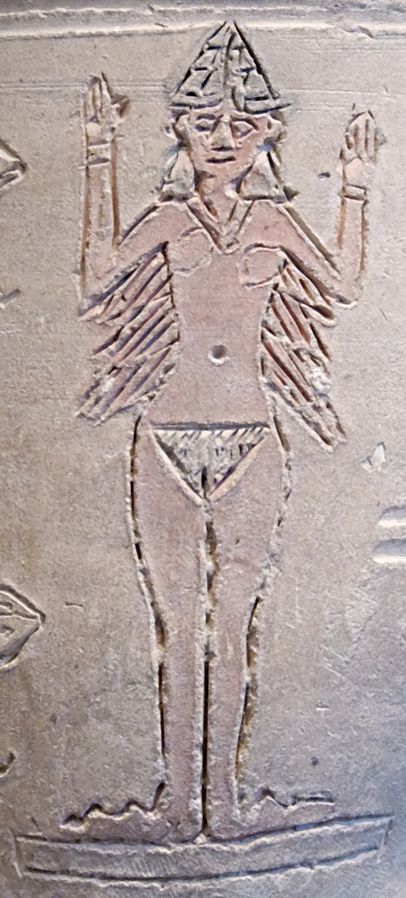
Sumerian Goddess Inanna
*Attribution:
https://en.wikipedia.org/wiki/File:Ishtar_vase_Louvre_AO17000-detail.jpg

Babylonian Goddess Ishtar
*Attribution:
https://en.wikipedia.org/wiki/File:Ishtar_Eshnunna_Louvre_AO12456.jpg
Another detail is that the black-purple holy stone was entrusted to the safekeeping of the Cathars in southern France, despite the fact that the Cathars there were engaged in conflict with the Roman Catholic Church during Pope Innocent III's Albigensian Crusade from 1209 CE until 1229 CE.
Subsequently, the remaining Cathars, who were holding the holy stone at Montségur in southern France, once again resisted the Roman Catholic Church around 1240 CE. The Cathars at Montségur were consequently attacked and defeated in 1244 CE.
On the final day of the Montségur Cathars in 1244 CE, the black-purple stone was smuggled out by four Cathar women and purportedly hidden, expected to be returned to the rightful holder (possibly after 700 years, around 1944 CE).
At this time, a group of knights were instructed to form a secret society around southern Germany, later known as Die Herren vom Schwarzen Stein (DHvSS: the Lords of the Black Stone). ("Holy Stone" coud be referred to as "Ghral" in Persian-Arabic.)
★
"Isais Graham Hancock"
http://grahamhancock.com/phorum/read.php?1,269455,269926
★
"The Black Madonna and the Swastika"
http://vortexcourage.me/2014/06/26/the-black-madonna-and-the-swastika-2/comment-page-1/
*
"Ishtar on Wikipedia"
https://en.wikipedia.org/wiki/Ishtar
*
"Inanna on Wikipedia"
https://en.wikipedia.org/wiki/Inanna
*
"Albigensian Crusade on Wikipedia"
https://en.wikipedia.org/wiki/Albigensian_Crusade
*
"Seige of Montsegur on Wikipedia"
https://en.wikipedia.org/wiki/Siege_of_Monts%C3%A9gur
>>>>>>>>>>>>
2.3.4.11 The Mongol Empire's Invasion of Kievan Rus' around 1240 CE and the Persecution
The Mongol Empire's westward invasion began around 1236 CE. People of the Jewish faith, believed to be descendants of Khazaria, are said to have fled northwestward to Kievan Rus' and the region of present-day Poland (as of 2020 CE). Kievan Rus' was defeated by the Mongols in 1240 CE, after which its Viking-influenced East Slavic population migrated northeast toward the area near present-day Moscow.
Poland resisted the Mongol invasion and survived, maintaining its alliance with Lithuania.
>>>>>>>>>>>>
2.4.1.2.2.4 Persecution of the Knights Templar
Meanwhile, the Knights Templar and the Order of the Knights of Saint John at Acre, their last major city, suffered a severe defeat, and they consequently lost that final stronghold in 1291 CE. The Knights Templar managed to survive temporarily on the small island of Ruad (Arwad) near Acre. The Order of the Knights of Saint John subsequently survived by relocating to the Island of Rhodes, which is adjacent to the southwest of Asia Minor.
Jacques de Molay became the Grand Master of the Knights Templar in 1292 CE.
However, the Crusaders and the Knights Templar were definitively defeated by the Muslims at Ruad in 1303 CE, thus losing their last strongholds in the Middle East.
The surviving knights returned to the Kingdom of France, joining other Knights Templar who were already stationed there.
King Philip IV of France was heavily indebted to the Knights Templar. Philip IV requested an additional loan, but the Knights Templar refused.
Subsequently, the Knights Templar was suddenly accused by King Philip IV of France, leading to the arrest of Grand Master Jacques de Molay and many other knights in Paris on Friday, October 13, 1307 CE.This move was supposedly because King Philip IV was indebted to the Knights Templar, or perhaps because the Order's belief system was deemed troublesome. The arrested Templars were tortured. (Ishtar's teachings might have included the fabricated theory of Evolution.)
Pope Clement V initially attempted to relieve the knights, but he consequently abolished the Knights Templar in 1312 CE. As a result, the Knights Templar were stripped of their vast property, much of which was transferred to the Order of the Knights of Saint John (in Rhodes) by Pope Clement V.
Some knights, including Jacques de Molay, were executed in Paris in 1314 CE, while other countries were generally sympathetic to the knights.
It is said that the surviving knights mostly either fled to Scotland (in the northern part of the British Isle), which was often in opposition to the Catholic Church, and formed Freemasonry; fled to Portugal as the Military Order of Christ (the Knights of Christ); or fled to the Order of the Knights of Saint John.
The property of the Knights Templar in Paris would have been transferred elsewhere, although France might have obtained a portion of the Templar's assets.
Freemasonry has been in conflict with the Roman Catholic Church ever since.
*
"Jacques de Molay on Wikipedia"
https://en.wikipedia.org/wiki/Jacques_de_Molay
*
"Order of Christ (Portugal) on Wikipedia"
https://en.wikipedia.org/wiki/Order_of_Christ_(Portugal)
Return to the Home Page